Česky
Česky


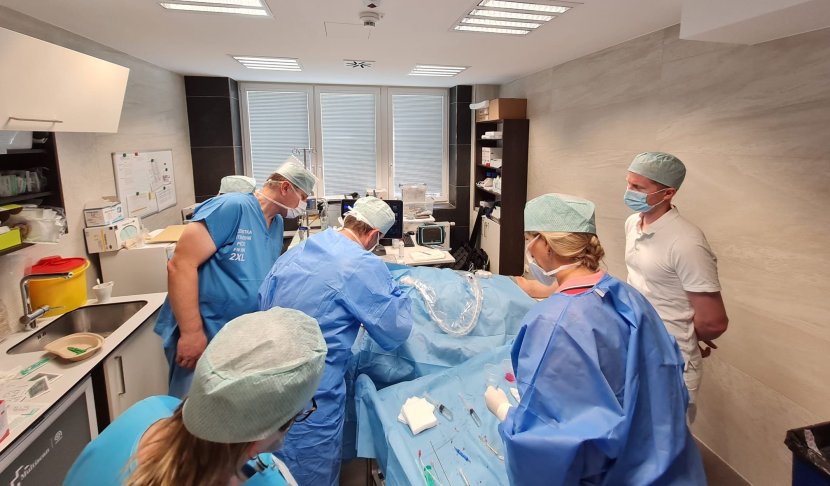
Until now, the introduction of the so-called PICC catheter (peripherally inserted central catheter) or venous port was the responsibility of the Radiodiagnostic Department of Pardubice Hospital. Now, the Comprehensive Cancer Centre is technically and personally equipped to be able to provide these procedures by itself.
"Preparations for the introduction of venous ports and PICCs took about a year and a half. I am pleased that the pilot operation went well and without complications. The realisation of the vision was possible mainly thanks to the support of the Director Ing. Mgr. Kulštejnová and the quality and erudite team of doctors and nurses. Our aim is to improve the safety of patients during chemotherapy administration and hand in hand with this to increase the number of patients referred according to current national and international standards. The dream ideal is that no patient in an oncology inpatient or oncology bed will have cancer treatment injected into the periphery," said Miroslav Žiaran, MD, who came up with the idea of introducing venous inputs directly at Multiscan.
What is the difference between a PICC catheter and a venous port?
A PICC catheter is a long, thin plastic tube that is inserted through the veins of the upper limb into the central vein leading to the heart, which is wider and more resistant than the superficial veins of the upper limbs. This is the safest venous entry. This procedure may be indicated by a doctor or nurse with the consent of the doctor. It is the venous entry that is most appropriate for patients with treatment planned for 3-6 months. The procedure is minimally invasive and there is a lower risk of complications and the ability to stay in a home environment compared to a traditional central venous catheter.
A venous port is a special chamber implanted in the subcutaneous tissue in the subclavian area, from which a catheter leads, which also ends in a central vein leading to the heart. It is a venous port that is so-called totally implantable (i.e. it is "hidden" under the skin). It is most suitable for patients with a planned treatment duration of more than 6 months. In addition to anticancer treatment, the venous port and PICC can be used for other purposes such as infusion, contrast agent administration during CT scanning or transfusion. The venous port can remain in place for several years.