Česky
Česky


Why did you choose the Good Angel?
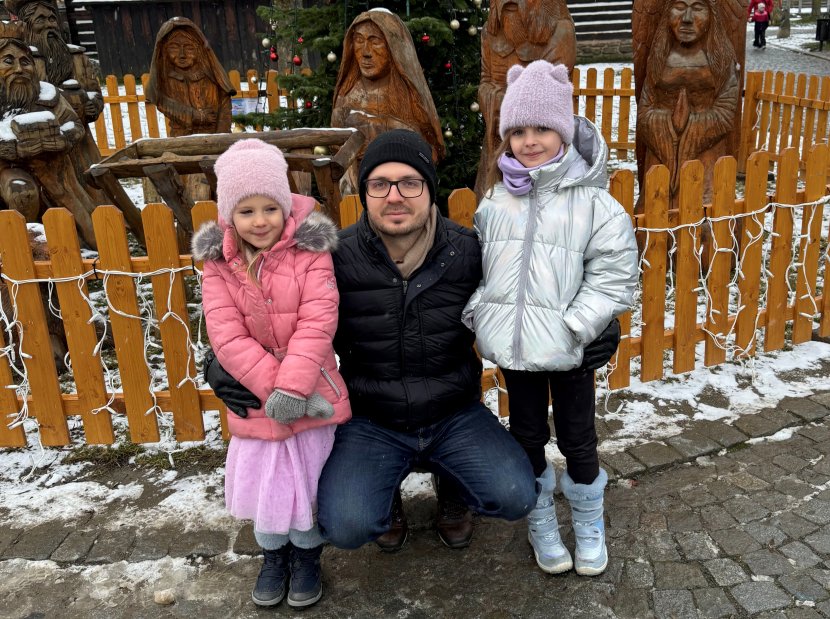
I was fortunate that I didn't need practically any of my own money for treatment and things around me, everything was covered by the insurance company. At the same time, I know that there are unfortunately many people who have a more difficult course of illness and need extra care and so on. As a dad of three little girls, it breaks my heart to see my children sick. That's why I decided to donate to them. I think of it as giving something back after my recovery.
But let's start at the beginning of your cancer journey. How did you know something was wrong, that it was a good idea to see a doctor?
I felt a slight pain in the affected area, but I thought for sure it was nothing. After a few days, when it didn't go away, I went to the doctor. I was expecting him to prescribe antibiotics and a resting regimen or something. Instead, the blow came.
Can you describe what went through your mind first?
Without embellishing, my first thoughts were of death. I didn't know much about cancer at the time, I didn't know there were such big differences between the different variants. And that I was unlucky enough to have a type that was easily treatable.
I'm told that often the hardest part is telling loved ones. How did your family react?
They all tried to be supportive. I'm sure it was hard for them too, in many ways harder than it was for me. Our children are still young, so we didn't burden them with the details of the illness.
What did your treatment involve and how did you manage it?
First, I had surgery to remove the affected organ. Recovery in hospital lasted a few days and then I had to take a few weeks off. Nothing terrible. I subsequently had one cycle of chemotherapy. That was more challenging. Luckily that cycle was only one, a lot of people have several and manage, so I didn't want to complain too much.
That was fairly quick. How long did it all take?
It was 3-4 months from diagnosis to the end of treatment. I feel great now, I should hopefully be completely cured.
You were treated at our cancer centre. How did it go during those few months?
Everything was absolutely fine. I was always well taken care of. I would especially like to mention Dr. Ulrich, whom I still go to for check-ups, and his care is excellent.
Is it possible to say in a few sentences what was the most difficult thing for you during your illness?
Mentally, the first two days were especially difficult before I got over it. You realise that no matter how much support you have around you, at the end of the day you are still alone. In your head, nobody comforts you or gives you a hand. You can discuss it with someone a hundred times, but in the end you have to deal with your thoughts alone, and that can be very challenging. Then in the days and weeks that followed there was the uncomfortable uncertainty of waiting for the results of all the tests. Not knowing what exactly is wrong with you and what the treatment will be and if it will work at all.
But family support is certainly very important during treatment.
Of course. I could always turn to that. But I was terribly pleasantly surprised by the wider community. A lot of people have called and written to me and asked how I'm doing, if I need help with anything, that sort of thing. Even friends I hadn't seen in a long time. It wasn't necessary in the end, thankfully, but it still made me happy and gave me positive energy.
What else kept you going?
Right at the beginning, before I knew the details of the diagnosis, I vowed to get cured for the sake of my children and my wife. I didn't want to leave my daughters to grow up without a father. I want to see them graduate from high school one day, lead them down the aisle, be a support system in their lives. That was a big motivation.
Cure patients often say that cancer completely changed their priorities. Does that apply to you, too. Do you live differently now?
The most tangible change is in lifestyle. It's not that I was living in a debauched way before, but I'm sure it could have been better. I realised that I'd have to be more health conscious than most people. I've lost about 20 pounds and I feel significantly better. The whole family is even more concerned now with what we eat and all the things around it. We've also focused on the details, like what kind of dishes we cook in, the material of the clothes we wear, and so on. My wife and I kind of make a sport of it. And of course, we can't forget the overall change in our approach to life. I've swung into things I've been putting off for a long time. I've come to realise that there's often no point in waiting for anything. Because no one knows how long we'll be here in this world.