Česky
Česky


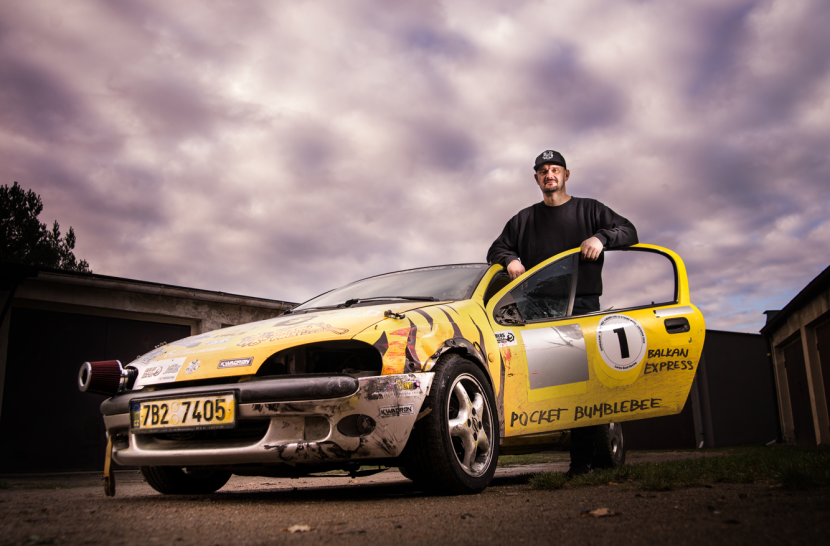
Multiscan is engaged in the provision of medical services in the field of diagnosis and treatment of cancer patients. How did you become an employee?
I used to work in a theatre as a set and set designer, then I had a serious leg injury and had to change jobs. I came to Multiscan as a graphic designer. And because I always enjoyed driving, I also started delivering plasma, special medicines or cancer patients for radiation and chemotherapy.
And when did you think you would start driving a car after hours?
It started by accident, actually. Three years ago, my friends and I signed up for Gumbalkan, where I met similarly "disabled" people. They told me about the amateur car races they were also organising.
First things first, what is Gumbalkan?
It's actually a tour of the Balkans where the only condition for participation is a homemade off-road car costing no more than 25k. You can't say it's a race. It's more of an orienteering rally. The winner is whoever makes it from the Czech Republic to the finish, which is in Romania. We have finished every time. But once we didn't make it back home to the Czech Republic. Soon after crossing the finish line, the engine seized and we returned home without a car.
When I look at the technical condition of your car, I can't imagine that you are driving on the Czech highway. How do you solve this problem?
You solve it by closing your eyes and stepping on the gas. (laughs) That's an exaggeration, of course. The technical condition is always up to standard and we certainly wouldn't want to endanger anyone.
What about the police, are you on good terms with them?
The police have stopped us several times, but they haven't given us a ticket. I think the fact that the car is sporty and not a total wreck plays a role. Most of the time, they're just amused and let us in.
What did your participation in the Balkan tour give you?
Definitely a lot of travel experiences. Most of all, I was surprised by what a car like that can withstand. And I realized that no one will ever make me get behind the wheel of an electric car.
So let's go back to the Czech Republic from Romania. You reached Gumbalkan and a new dimension of amateur circuit racing opened up...
That's right. As soon as we got back, we set about converting the car from an off-road version to a racing special. And as soon as we could, we warmed up the tyres on the track. There's about six races a year, we usually manage three or four. Even though it's a completely amateur thing, we have to have money for gas, tires, the circuit and other things related to it.
How are these speed races different from the aforementioned Gumbalkan?
In the Czech Republic, it's a real speed race on a circuit where around thirty cars start. They run for a full six hours. We specifically drive in two and take turns driving. Otherwise, the rules are similar: cheap and home-built car. The bigger the fluke, the more fun. Our car cost 16 grand.
What kind of car do you actually race in? I don't want to offend you, but you can't really tell.
It's a 1997 Opel Tigra, popularly known as the secretary's handbag, with a 1.4 66 kW engine. I took the car and the first thing I did was remove the rear seats and the boot lid, making a sort of pick-up truck. I modified the chassis to make it both off-road and track-ready. You'd also look in vain for a catalytic converter or muffler on the exhaust system. And last but not least, there are snowboards bolted to the rear of the car that serve as an aerodynamic element.
"I love engines and their mechanics, so I don't think I'll just get behind the wheel of an electric car."
Sounds like a very dangerous ride. So where do you stand on the scorecard?
We've completed the Gumbalkan twice and our best finishes on the circuits so far are sixth and seventh. That's why we've now decided to put a stronger engine in our car. It will have more torque, which should help us especially in the corners.
What would you like to achieve in amateur racing?
Definitely to try what it would be like to stand on the podium. But if I were to be more modest, it would be quite enough if I still enjoyed it as much as I do now. It's not quite about the cups sitting on the shelf in your garage, it's about the great fun and release.
Photo: Jindřich Kodíček, Josef Vyškovský