Česky
Česky


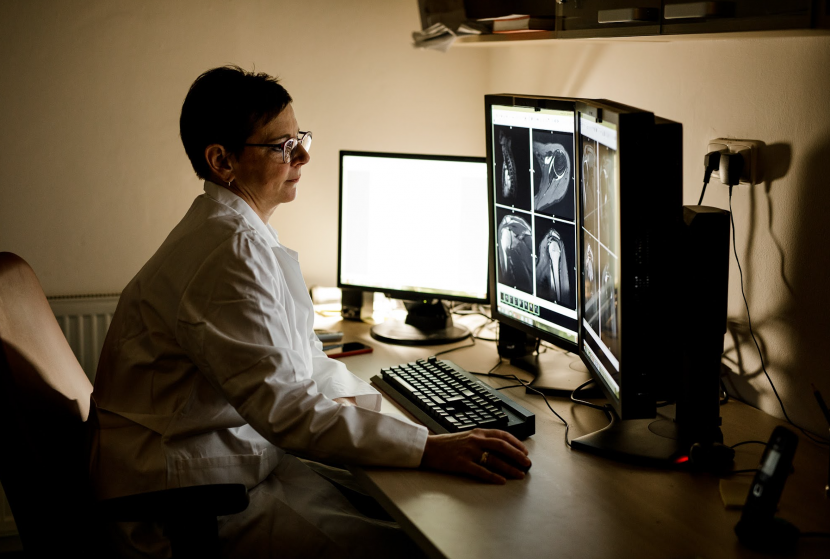
You are the head of the radiodiagnostic department, what is your job?
The radiologist's job is mainly to plan the scope and type of examinations, such as computed tomography (CT) with native or contrast medium, and then to evaluate them.
What diagnostic methods do you use in your department?
In our department, we perform conventional radiography, which are the familiar X-ray images, ultrasound examinations, CT scans and magnetic resonance imaging.
Which patients come to your department with which health problems?
We examine a wide range of patients. Patients with pulmonary problems, back and joint pain and after injuries most often come for X-rays. On ultrasound, the most common patients are those with abdominal pain and suspected venous thrombosis or narrowing of the limb arteries. On CT, the majority are cancer patients who are checked during and after treatment. On MRI, it is patients with neurological problems such as back pain, tingling in the limbs, headaches or dizziness, musculoskeletal problems (pain or injuries) or patients with tumours of various types.
How do the different technologies, especially CT and MRI, differ? What can and cannot they do, how do they complement each other?
CT uses X-rays that are picked up by detectors as they pass through the body, from which a computer then constructs a final image of the area under study. There is a strong magnetic field on the MRI, and the computer calculates this in turn based on how the different tissues behave as it changes.
Doesn't it bother you that you're not actually treating patients, just "looking" at them?
I don't mind looking at images, I have always been more focused on instrumentation than treatment.
How much does radiodiagnostics help doctors treat patients?
Determining the cause of the patient's difficulties and the extent of the disability is the basis of correct and successful treatment.
Is there a special field of study in radiodiagnostics?
General medicine is studied at the faculty, and only after graduation, when a physician starts working, does he or she decide which direction to take. After several years of training, he or she takes a certificate in radiology and imaging.
How did you get into this field in the first place? Am I right in imagining that you were attracted to medicine and at the same time to modern technology and diagnostics? Or was it something else?
At the time I started my job, there wasn't much choice. I was really interested in modern technology, so between internal medicine, long-term care and radiology it was a clear choice.
How physically or mentally demanding is radiology? Do you ever need to completely switch off, forget about your work and your patients?
Most of the time we sit in a dark room and concentrate on the computer screen, some examinations are easier, some are more complicated. Then we need to switch off for a while or think about something else.
What do you do in your spare time?
I find the best way to clear my head is to be out in the fresh air, play sports or listen to music.
Why do you think it is that you have to wait several months for an MRI scan, for example? Are there not enough of them? Or is there a shortage of specialists?
Waiting times for MRIs have been getting shorter recently. Together with the insurance companies, the instrument commission has authorised the installation of more machines. It is true, however, that there is a shortage of radiologists with experience in MRI and that some of the machines are not fully utilised. Magnetic resonance imaging or computed tomography is the same as aircraft, which must not be allowed to sit on the ground unnecessarily. That's why we go seven days a week and usually on holidays. We're not far from the centre of Pardubice in one of the best equipped diagnostic centres in the Czech Republic. Over twenty-one thousand people a year are examined here for MRI and CT scans alone. Most of them are patients who do not suffer from any fatal disease, but some of them are cancer patients.
Are there also good and worse doctors in radiodiagnosis, like in surgery?
In every job and field you will find people who do their job very well, well, and those who do it worse.
Is there any place in the human body that cannot be checked with today's modern technology?
We can show almost anything, but the truth is that there are difficulties that have no graphic correlate.
How has modern technology changed, evolved, over the last few decades? What do you consider the most significant discovery?
There has been a significant shift in radiology over the years. There has been a shift from imaging on conventional film to digital processing, which allows images to be viewed at any location. This means that by the time the patient returns to the outpatient clinic after imaging, for example, the orthopaedic surgeon already has the images on the computer. If he wants to consult the images at a clinic in another city, we send them there over the Internet. The examination time has been reduced in both CT and MRI, and both modalities use gentler contrast agents and so-called hybrid methods.
Is there any difference in the state-of-the-art equipment in the various medical institutions in the country? That is, do some facilities have better diagnostic equipment?
The equipment of individual workplaces varies, of course. It depends on a number of circumstances, such as the focus of the facility, what equipment they choose to invest in, what procedures they have contracts with insurance companies for, and so on.
And how does the Czech Republic compare with developed countries?
We are not lagging behind in comparison with developed countries in terms of availability and quality of examinations.
Where is radiodiagnostics going next? How would you predict the future of radiodiagnosis?
I believe that in the future there will be a greater use of hybrid technologies that allow the assessment of the metabolism of the tissues being examined. Furthermore, there will be a shift of some examinations from CT to MRI as the number of machines increases and the examination time decreases. The advantage of MRI is the absence of radiation.
Author: Pavel Baroch, Interview, issue No. 6/2021