Česky
Česky


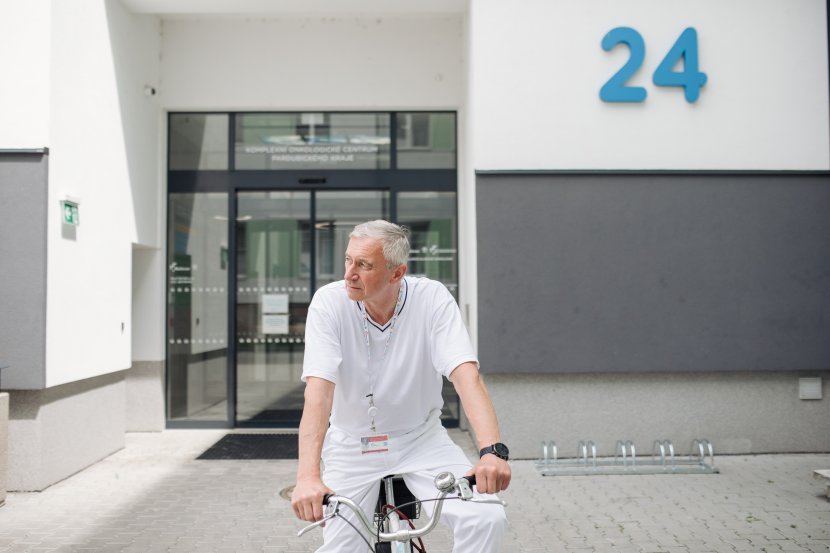
You've been working at Multiscan as an orderly for over 11 years. How has Multiscan changed in that time?
It's changed a lot. To make a long story short, M.A.S.H.e has become Chicago Hope Hospital. We used to be in this little gray house, it was "field conditions." Now we have a modern centre that is beautiful and functional. The organisation of work has improved. The whole thing works like a well-oiled machine. I appreciate the operation of the pipe mail, it saves me a lot of steps, but I still walk 10-12 kilometres a day, measured by a smart watch. My only regret is that in the house we as staff were more in a pack, here unfortunately I wouldn't see some of the nurses for days if I didn't go to ask if they needed anything.
What's your job? What does your working day look like?
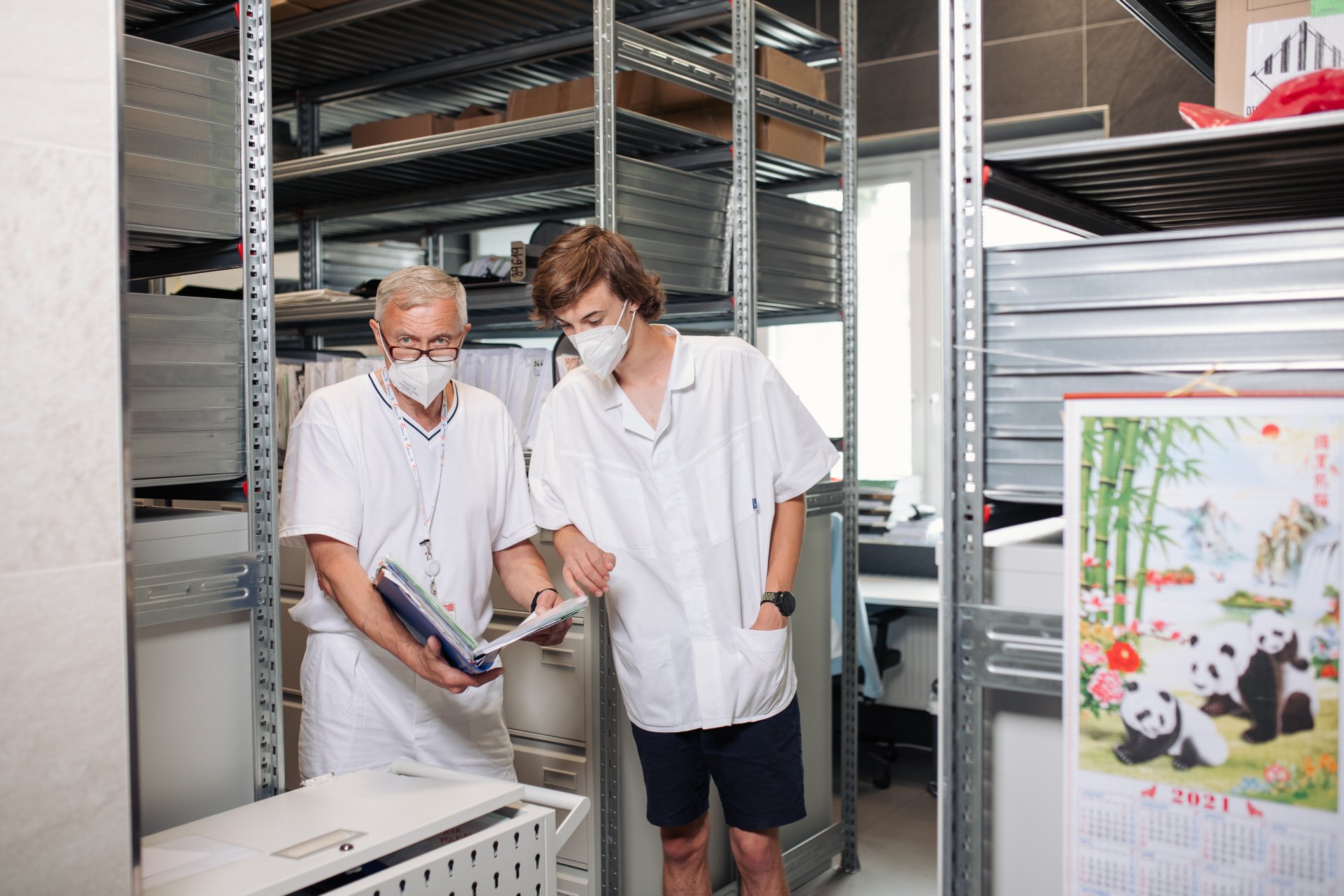
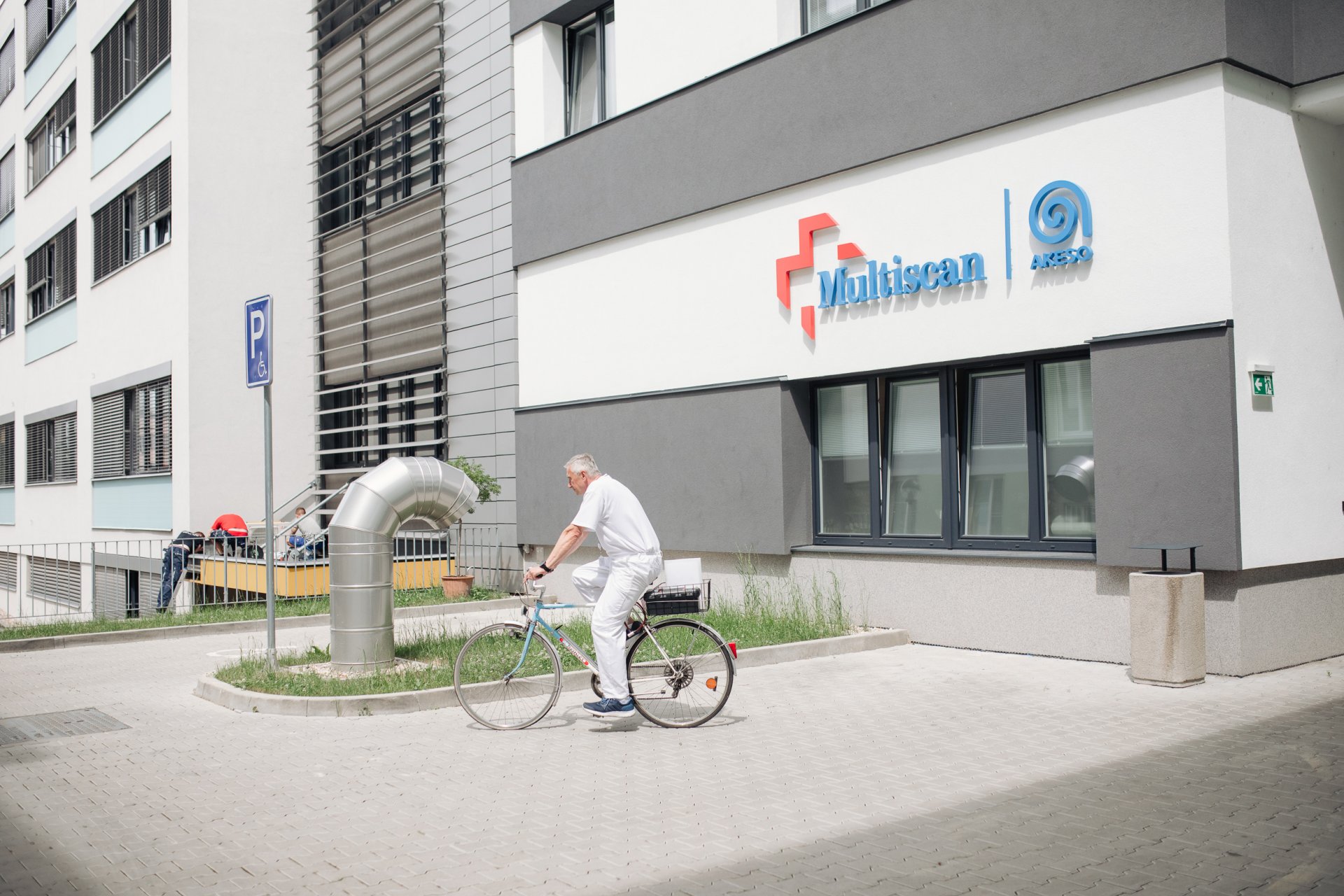
We start work at seven. First, I check that the necessary medical supplies are everywhere. I'll bring the lab results from the previous day. I'll bring in the things that need to be sterilised. My main activity, however, is the ongoing collection of blood and biochemical samples and their delivery to the laboratories - either by pipeline mail or in person. I also accompany patients to various other examinations (X-ray, ultrasound, CT scan...). I continuously clean the ward, make the beds, prepare the laundry for washing, sort the laundry, file the medical records in the archive. Before the end of the service, I clean the hospital and take out hazardous waste. Shift ends at 15:15. Fortunately, I'm not alone in all this. I share the work with a great colleague. And my time is also saved by the bicycle I ride around the PKN campus, which makes me quite popular.
But you're not originally an orderly. What was your professional development? Why did you leave your original profession?
I wanted to be a PE teacher, but an injury put a stop to that, so I remembered that I was doing a mechanical engineering school and started working as a designer. After the revolution, I also ran a business for a while. Then a friend lured me into the public sector. I helped start the Pardubice employment office. I was in charge of active employment policy, support for start-ups, and I started a system of community service. But in the evenings I was still sketching here and there. I married a wonderful woman. First we had a daughter who went to college. But our son, who is five years younger, has always needed and will always need extra care. I wondered what to do next.
"I first went to try it for two months and I've been here for over 11 years."
What led you to the paramedic position?
At 50, I found that I was no longer enough for those young active managers, that I didn't have their "pull". I found I was missing the train professionally, I didn't want to get used to scribbling in a computer program and I was tired of sitting through training sessions all the time. I guess I had always been a caring person. Along with my wife, I took care of my mother - until she died. Even caring for a son is generally more challenging. I wanted to spend more time with my family. At that time, I found an advertisement that Multiscan was looking for an orderly. I first went to try it for two months and I've been here for over 11 years.
What do you enjoy about your job?
I like the fact that I only work day shifts and I go home with a clear head. The work is varied, it's not stereotypical. We're a good team. I feel very comfortable at work. I like being able to help other people.
What is AKESO like as an employer? Do you enjoy any employee benefits?
I have to say that I admire the work of the whole AKESO group. I appreciate that the owner of the company surrounds himself with professionals. I am especially happy for the team, which is very friendly. Most importantly, problems are solved here, not swept under the table.
I really like that we have healthy snacks (fruit, vegetables) on Fridays. I know that our employer contributes to our meals in the factory canteen, but I rarely find a whole half hour for lunch. I admit that I don't have a great overview of all the benefits myself, but from what I've heard, employees are also offered company apartments and there are various activities for children. I guess having smaller kids, I definitely take advantage of those benefits more.
What has being a paramedic given you?
I'm an excitable person, but I've calmed down a lot here. There's a whole range of illnesses and it's only here that you see how much you have to value your health. Everything else is ephemeral. It's no use arguing and spoiling your life. I have a great humility towards life now.
You reached retirement age earlier this year. But you're not going to retire.
Like I said, I like helping people. I'm glad I can still work. I'm grateful to be relatively healthy. True, I have some health problems from playing sports when I was young, but that's a minor thing. I'd be bored at home. I feel young and I have to keep up with my wife who is 12 years younger than me (laughs).
You were a successful sportsman in your youth. What was your greatest achievement?
I started playing sports after my dad died. My mother, sister and grandmother tried hard. My brother-in-law was also very supportive and he steered me towards sports. Sport gave me confidence. I wanted to do the triple jump, but I couldn't do it because of my health. So I took up long jump. My coach wanted me to do hurdles. I was good at that, but only as long as it was the low hurdles. I have to say, my coach was a decathlete and he saw that in everybody. So I tried all the decathlon events as well, but I wasn't good at the throwing events. For example, I have a "record" that I was the slowest long jumper of the Czechoslovakia in the 100 m sprint (laughs). In the long jump I have a personal record of 729 cm (the then record was 805 cm - ed.). And then I broke my achilles at my first competition in the army and that was the end of performance sport. Probably my greatest success was the 5th place in the indoor championship of men of the Czechoslovak Socialist Republic.
Your work is physically and mentally demanding. How do you compensate for the stress?
First of all, I try not to admit the mental stress. I admire everyone who works at Multiscan. You must be really good here and I'm glad to be part of this great running organism. I've had to learn not to get attached to patients, even though they have troubled lives and I'm happy to help them anytime.
We have a house with a garden, so there's always something to do. And my family and I love to travel. My son knows all the castles and chateaus in the Czech Republic, so my wife and I try to travel with him in our spare time and explore these beautiful places. This year we are going to explore the area around Mariánské Lázně.
What are you planning for your real retirement?
I want to work as long as I can. My mother, who my wife and I took care of, worked until she was 75. So I hope I inherited longevity from her. When I can't do that anymore, I'll walk and hopefully travel.