Česky
Česky


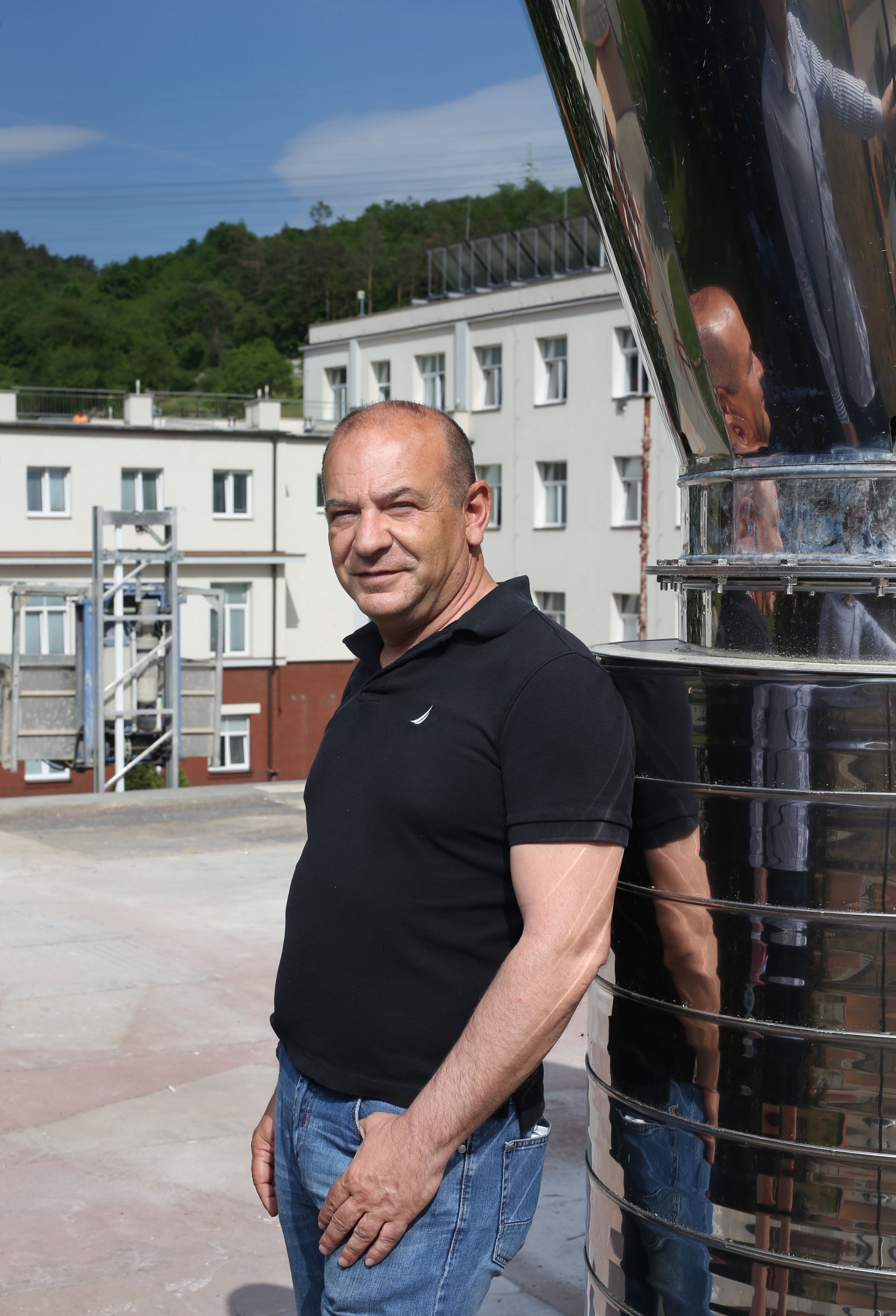
This approach is characteristic of entrepreneurs originally from Greece. The owner of the second-largest private network of medical facilities in the Czech Republic is obsessed with investing in property and does not understand when someone neglects it. In ten years and roughly three billion, he has transformed dilapidated hospitals in Beroun and Hořovice into truly state-of-the-art facilities. Moreover, hundreds of millions more are now on the way.
Since 2007, when you privatised the hospitals in Hořovice and Beroun, you have, in your own words, invested around CZK 3 billion in them. Will it ever pay off?
The return on these investments has a horizon of "never". I mainly value assets. I invest in a medical facility that looks great and attracts the interest of patients. It's not a classic investment where you spend a hundred million and two years later you know you have a hundred and ten. We're talking about such a long spread over time that it's not realistic for me to think of it as an investment vehicle. Just for comparison: it cost four and a half million to furnish two superior rooms. That has no return.
Did you know at the beginning that the amount spent would be so large?
The demands for investment come in ways that don't lend themselves to much planning. Of course, we have a vision that we follow, but sometimes these things come by chance. I used to study national economic planning. That means I should know in advance what will cost how much money. But I've been out of school for over twenty years now, and in practice I recognise that I've probably forgotten all the theories just in case.
How did you get into the health care business in the first place?
I started sometime in 1998. I bought a half share in a diagnostic centre in Prague 4 from a friend. Then I left all other activities and concentrated only on healthcare.
You're still investing heavily. You're expanding and modernising the inpatient aftercare unit, you're planning a billion-dollar project for a Mental Health Rehabilitation Centre...
...and there are other things going on. We'd like to build two more operating theatres in Beroun and we'll need to build 25 new beds for them. In Pardubice, where we have one of the oncology centres, we will be building an oncology pavilion, in Hořovice we are completing a nursery for employees, a parking lot for patients, an inpatient ward focused on paediatric patients who require follow-up and long-term intensive care (they now lie for months or years in the ARO and ICU wards), five operating theatres and 120 beds to be able to meet the demand for care in our facility.
Why such an investment?
We are trying to improve services. On the other hand, this is reflected in a lot of interest from the public, which we are pleased about, but unfortunately it also results in longer appointments and people waiting longer and longer to get in. We are a bit hostage to our success. We have to invest.
How much is all this going to cost?
There might be a sum available, but I don't want to add it up because I'd have to go crazy. My people say it's 400 million. I don't know, I guess it is.
The current government is not very keen on privatisation, much less privatisation of hospitals. But how do you feel about the argument that private owners would keep only the lucrative specialties in hospitals, thereby reducing the availability of the others?
The government is telling half the truth. It is true that privatisation is not a universal cure for better services. But on the other hand, it is not the rule that privateers come to tunnel. If I compare it to industry, look at Skoda Auto. Surely no one today regrets that Skoda was privatised. I see the health sector as a strong issue that the Social Democrats like to grab onto. It paid off once when they won a regional election with their campaign against fees, and so they continue to campaign against privatisation. Just as Mr Babiš has found a theme that everyone is stealing, they have decided to defend hospitals. Yet no one wants the hospital network to be completely privatised.
So what is the problem?
The management of the hospitals. They are often run by politicians chosen according to party rules, which is a mistake. Look at what the hospitals around ours look like, what their numbers are and what is being invested. Only what is subsidised gets fixed. We do not receive any, yet we have invested three billion, we are not in debt and we have above-average equipment.
Around 200 doctors leave the Czech Republic every year. Do you feel it?
Fortunately, we don't have any major problems with staff. We have around two thousand of them, we try to accommodate them with benefits and various perks, so the only thing missing from the ideal situation is a slightly higher number of nurses. The advantage is that the turnover is minimal, and there are long-term quality people in important positions who have been with us for an average of over ten years, which greatly helps the stability of the team and the continuity of work and the quality of care provided.
Coming back to the political perspective. In your view, isn't there too dense a network of hospitals in the Czech Republic, which again is something that the left-wing government is advocating?
The network was drawn up sometime in the time of Maria Theresa. Back then, of course, there were no motorways, ambulances and all the conveniences we have today. Today we have an excellent infrastructure, from Prague you are in Pilsen in 40 minutes and there is no reason to have so many hospitals on the way. In addition, every facility costs something, whether it is for repairs or its construction. At the same time, today's medicine does not need the bed capacities that exist in the Czech Republic. We need to get to the point where patients will be in hospital for shorter periods of time and will be treated in a more modern way. The Czech Republic is also not rich enough, with such a dense network, to have high-quality and top-paid staff, excellent equipment and repaired pavilions everywhere. Everything should be concentrated in larger units in fewer places.
Why can't public hospitals do what you do? What are you doing differently?
It's all about people. Some public hospitals are great. Like the one in České Budějovice. But if somewhere is doing well and you want to give the director an adequate salary, there's a problem and you get fired. The South Bohemian Region is the only one where the healthcare system works. Look at North Bohemia or Hradec Králové. They have similar conditions but completely opposite results. It can be good everywhere if there are capable people.
And practically? Do you have lower costs, buy cheaper equipment, medical supplies?
I have to go back to what I was saying. Everybody could buy well, but there must not be political agreements around it. The ties between politicians, hospitals and suppliers are such that they cannot be mended. The CEO wants to do something, the CEO doesn't like it, the CEO calls the MP, and so on and so forth. These hospitals should have independent management. This is not where politics belongs. It's not the ministries that have a political direction.
Going back to 2007 again, what was the first thing you had to do here?
I can still hear the words of my mother who told me the first time we went together to visit the hospitals I had just bought. She said: I always thought I had a smarter son... She knew I had no experience running a hospital. I'd only been in the hospital for the birth of my two children, then for my brother when he got hurt on his motorcycle, and for my grandmother when she broke her neck. I mean, I have absolutely no experience in hospital management. But I suspected that I mustn't look for complexities and should mainly follow common sense, as I know from experience that it usually works. Looking back now, I can say that in the end it wasn't as difficult as it seemed at first. Of course I was not on my own, I had capable people around me, especially Dr. Calta. He wrote the concept with which we bid for the privatisation of the facilities, and it was also he who showed me the initial direction to take and what to improve. But at that time he didn't know what a nut I was and that I was going to take everything from the ground up.
You also often complain about so-called individual rates. But that's also the insurance company's answer to the influx of patients, isn't it?
An influx of patients means an increase in the care provided. Insurance companies usually don't take into account the entire increase in reimbursement, even if it is directly caused by an increase in the number of patients treated. They will only take part of it into account or not at all. As a result, the individual rate steadily decreases. In one of the insurance companies I was even at 17,000, which is a critical situation.
Why is there such a hunger among investors to acquire hospitals and healthcare facilities? An example is the Penta group or the Hartenberg Capital fund, where Andrej Babiš invests.
Frankly, I do not understand this. Either these financial groups have decided to do charity work or they want to use these purchases to put pins on the map and then sell the volume as a whole at a higher price than the facilities had individually. I don't see any other sense in it. The current system is set up so that they can't make a return by simply doing business unless they pump huge amounts of money into the hospitals.
Is there anything left in the market to buy?
If we take a business view, a public hospital that has an influx of subsidies and yet fails must be so desperate that it simply has no place in the sun. There may be someone who will buy it, but then the question is whether the county should sell such a hospital or restructure its healthcare network and turn a failing hospital into, say, a successful aftercare clinic.
Are you looking around for purchases?
It's nice on the surface to have ten hospitals, but in practice it's useless to me. I want to develop what I have and in the future maybe think about a third hospital strategically located near Prague. Nowadays there is no need to have a hospital outside every city. People don't have catchment hospitals, they can choose. And I know that if we are good, they will choose us. We don't have to come to them by buying a hospital, patients from Opava and Aš come here. They come themselves. In Hořovice, for example, we perform 38 percent of surgical procedures in the whole country for patients with non-specific intestinal inflammation, such as Crohn's disease or ulcerative colitis.
Have you had offers to sell off your facilities?
Not lucrative enough for me to consider it, no. Last time I jokingly asked for a billion euros, but it's clear that my hospitals have become an unsellable commodity. They're overinvested. The wall around the Beroun hospital alone cost 18 million. Nobody is able to buy it and take into account everything I have invested here. I'm not in business to sell. I believe that my daughters will continue the development one day after me.
What are the preparations for the Mental Health Rehabilitation Centre? I know you've applied for 40 percent of the EU funding.
The problem is that those who evaluate projects want mediocre things. They can't understand that I want more, something extra. They were scared when they saw my plans. They expected me to take a block of flats, paint it, replace the linen and start a business. But I came up with a six-star accommodation and medical facility. Why shouldn't people in the Czech Republic deserve that when other places have it?
So you failed in your application.
It's already obvious who's getting the money before it's allocated. I failed, but I'm not sorry. Maybe someday I'll learn to play their game, too.
What does that mean in practice? You're backing out of the project?
No, I'm not. I've lived here for 30 years, I have children here, and I'm going to die here. I want to realise myself here and follow my vision. I've already paid 18 million for the projects at the centre. But I don't have a billion in total, so I'm gonna take it easy. I'm not gonna make them that happy if I quit.