Česky
Česky


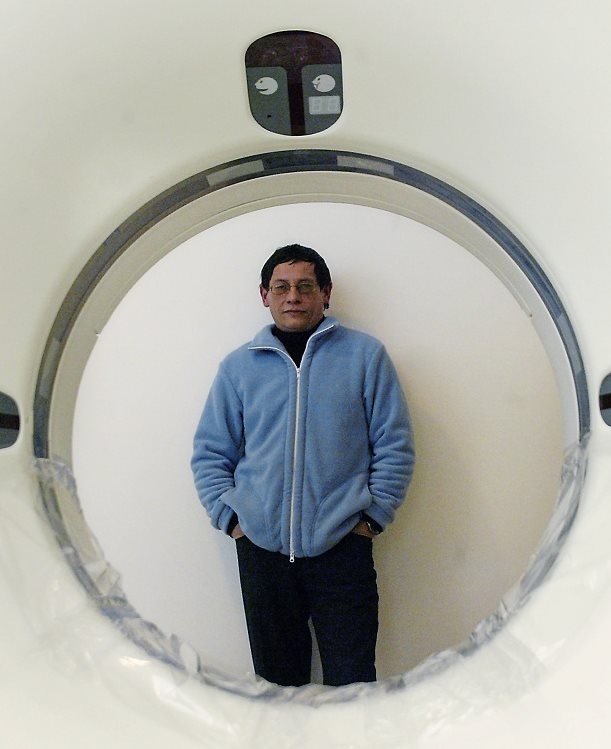
Oncology in Pardubice can be imagined as a hospital inside another hospital. The private facility Multiscan invested in and equipped a new department a few years ago. However, it must and wants to cooperate with the regional hospital that surrounds it. The coexistence of a private investor with a county facility has led to conflicts in the past, as county leaders believed that Multiscan was raising money that the hospital could earn on its own.
Years ago, there was a truce, but now there is peace, although some tensions may remain. But what Finance Minister Andrej Babiš branded the entire regional hospital with a few weeks ago, oncology does not have: a bad reputation.
"The department is one of the best in the country, both in terms of equipment and staff. There is nothing to be ashamed of. And as for litigation. Yes, the representatives of Multiscan and the hospital attacked each other, gradually it all blew up and in the end it turned out that it was nothing substantial," said Jaroslav Vaňásek, the head of the Pardubice Oncology Centre.
A few days ago, the renowned oncologist Professor Jiří Vorlíček highlighted in Lidové noviny how the Pardubice Oncology Centre cooperates with regional centres. Does it really work so well in our region?
We have detached outpatient clinics in the region, so even if patients do not come directly to the cancer centre in Pardubice, we supervise their treatment in Ústí nad Orlicí, Svitavy and Chrudim. Elsewhere, there is some animosity between smaller and larger centres, but here everything is under one roof and there is no problem between the centre and the districts.
So, in your opinion, it can happen elsewhere that the oncologist in the district says - I can do it myself. But you can say to him, 'No, you can't do that, we will deal with it?
That is exactly how it works. We work as a team, many doctors compete with each other, there is an exchange of opinions, information. When someone makes himself the boss, he can get into a routine and use sub-optimal procedures. In addition, we now have a vision that we will create a unified system of care in the region so that we meet with specialists and chiefs of individual hospitals not only over patients, but also over our activities, so that they are more involved in the problem.
Three to four thousand people get cancer in the Pardubice Region every year, how many of them come to your specialised centre?
For many patients, these are not tricky diagnoses that can be solved simply, with a minor surgical procedure, and they do not need a centre, so care can be provided directly in the districts. As far as Pardubice is concerned, we have about 1,000 radiation patients per year, and about 2,000 people per year undergo chemotherapy. Some people leave the region for Hradec, Olomouc, Prague and Brno. Often these are diagnoses that are rare, which we do not deal with. On the other hand, some patients come to us from the Central Bohemia region, especially from the area around Kolín.
The key for patients with this diagnosis is speed. Fast diagnosis and fast treatment. Are you satisfied with how fast you are?
I'm not. The process from diagnosis to treatment should go faster. From our point of view, it's annoying that we are at the end of the chain, the patient counts it from the moment he first comes to the doctor, then he goes through a series of tests, waits for the results of the MRI, then they need to complete a CT scan, they book him in for surgery. Then the patient comes to us, it's the first day, and they ask: When are you going to do something with me? Yes, it's his first day with us, but he's been seeing doctors for a month and a half. He sees it as a system, and the system drags on. Having cancer, knowing about it and waiting a month and a half to find out what's going to happen to me, I'm angry too.
I thought you guys cut the wait down to two weeks...
For outpatient radiation, yes, within 14 days. For inpatient radiation, the availability for patients from our region is good thanks to the cooperation with all inpatient departments of our hospital. The usual waiting time for an inpatient is two to four weeks. However, we also receive patients from the Central Bohemia region. For chemotherapy there is no problem, it is a matter of a few days, but radiation takes six to seven weeks. Therefore, there is sometimes a month's wait for beds. Sometimes it is difficult for patients who have already had treatment to find another bed in the hospitals in the region. Better cooperation with the region would free up a number of beds. I assume that once the hospitals are merged into a single entity, cooperation will be easier.
You need help from the hospitals. What else would help you?
We want to build a new chemotherapy inpatient unit, which is cramped. It should be expanded, but we are still looking for a suitable location on the site together with the hospital.
What should a person do to avoid coming to your centre?
For early detection, it is important to use basic screening programmes; they are well controlled and organised. Mammary and gynaecological screening, screening for digestive tract cancers is crucial. It is also possible to contact different doctors when one feels that something is not right. For example, at Žlutý Kopec (editor's note: Masaryk Cancer Institute in Brno) a system of preventive comprehensive examinations is offered. You can go there and have a comprehensive examination.
Would you recommend that?
If the population would take advantage of the possibilities it has, which are free, it would be enough. When women come in with breast cancer in the early stages because of screening, it is millimetre-sized deposits. Then, of course, the treatment is completely different from that of a tumour that is incurable from the outset.